Quick answer
A main sewer line clog is a blockage in the single pipe that carries all your home's wastewater out to the sewer or septic tank — the tell is several fixtures backing up at once, gurgling toilets, and water rising in the lowest drain when you run another. Precision Plumbing & Septic diagnoses and clears main sewer line clogs with camera inspection and hydro-jetting across Canton and Cherokee County, GA. A single slow sink is a DIY job; a main line clog is not — it needs a pro before raw sewage backs up into the house.
Flush the toilet and the shower drain bubbles. Run the washing machine and the basement floor drain gurgles up dirty water. If your problem is jumping from fixture to fixture instead of staying at one sink, you’re not looking at a normal clog — a main sewer line clog blocks the single pipe every drain in the house empties into, so when it plugs up, everything downstream backs up at once. That is a completely different problem from a hair-clogged bathroom sink, and it does not fix itself with a plunger or a bottle of drain cleaner.
We’ve cleared main line backups across Canton, Woodstock, and Cherokee County for 25+ years as a licensed Georgia Master Plumber operation. Because one crew here runs both the plumbing and the septic side, we can tell in one visit whether the blockage is in your sewer line, out at the county main, or backing up from a full septic tank — three different fixes people constantly confuse.
Main line clog vs. a single-drain clog: how to tell
The fastest way to know what you’re dealing with is to notice how many fixtures are affected and which one overflows first. One slow drain is local. Multiple drains acting up together — especially the lowest one in the house — points straight at the main line.
| Sign | Single-drain clog | Main sewer line clog |
|---|---|---|
| Fixtures affected | Just one sink/tub | Several at once (toilet, tub, washer) |
| Where water backs up | At that one fixture | The lowest drain first (basement, floor drain, downstairs toilet) |
| Toilet behavior | Normal | Gurgles or bubbles when you run a sink or washer |
| After running the washing machine | No change elsewhere | Water rises in a tub or floor drain |
| Plunger / drain cleaner | Often works | Does nothing — clog is too far down |
| Sewer smell | Rare | Common |
That “run one fixture, a different one reacts” pattern is the giveaway. All your drains tie into one main line before it leaves the house; a blockage in that shared pipe has nowhere to send the water except back up through the lowest opening it can find.
What causes a main sewer line clog around here
North Georgia’s soil and tree cover make a few causes far more common than others:
- Tree roots. The number-one cause in older Cherokee County neighborhoods with mature hardwoods. Roots find the tiniest gap at a pipe joint, grow into the line for the moisture, and catch everything flowing past. The EPA lists tree roots entering “through defects or openings in a sewer line” as a leading cause of sewer blockages (EPA, Sanitary Sewer Overflow FAQ). If your backups return every few months, this is the prime suspect — more on that in our guide to tree roots in your sewer line.
- Grease and “flushable” wipes. Fats, oils, and grease cool, harden, and coat the pipe walls until the channel closes; wipes and paper towels snag on the buildup. Grease and household products are a top cause of sewer blockages nationally, which is why the EPA pushes homeowners to keep them out of the drain entirely (EPA, Fats, Oils and Grease program).
- A pipe belly or broken section. Older cast-iron and clay lines sag or crack, and North Georgia’s red clay soil — which swells wet and shrinks dry — shifts poorly bedded pipe out of alignment. Solids settle at the low or broken spot and clog the same place forever.
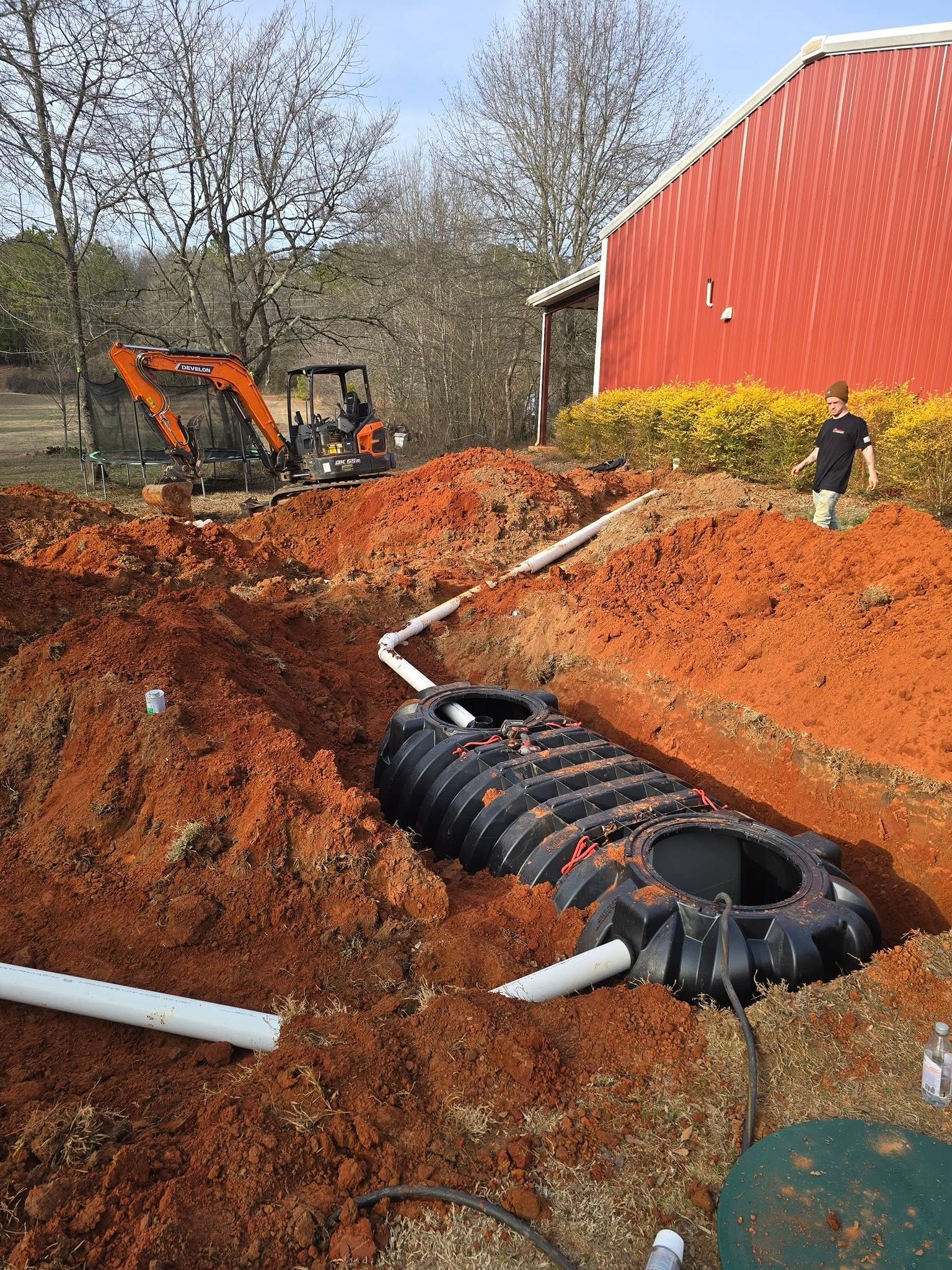
- A full septic tank. If you’re on septic, a “main line clog” is often the tank itself. When it fills with solids, wastewater has nowhere to go and backs up toward the house. Snaking the line does nothing because the pipe isn’t blocked — the destination is.
Who clears a main sewer line clog in Canton, GA?
Precision Plumbing & Septic clears main sewer line clogs across Canton and all of Cherokee County — we camera the line to find the exact blockage, then hydro-jet or make a targeted repair, and we answer emergency backups the same day. We don’t guess where the clog is; we put a camera down the cleanout and look. That matters because the fix for roots (jetting), a belly (spot repair), and a full septic tank (pumping) are three different jobs, and paying for the wrong one is how homeowners waste money. If the blockage turns out to be a collapsed section, we handle the sewer line repair too, so it’s one crew start to finish.
What NOT to do while it’s backing up
- Stop running water immediately — every flush, load of laundry, or dishwasher cycle adds to what’s already got nowhere to go.
- Don’t pour chemical drain cleaner down a main line. It won’t reach a clog that far down, and it turns any water that does back up into a caustic hazard for whoever cleans it.
- Don’t wade into standing backup water bare-handed. Sewage carries bacteria and viruses; the CDC recommends gloves and boots and keeping it off your skin. If it’s already on the floor, rope off the area and call.
- Find your cleanout. It’s a capped pipe (usually white or black, 3–4 inches) near the house or in the yard along the sewer path. Popping that cap can relieve pressure and send the backup outside instead of up into the house — and it’s the access point we’ll use.
How the clog actually gets fixed
Once we’ve cameraed the line and know the cause, the fix matches the problem:
| Cause | The real fix | Ballpark |
|---|---|---|
| Grease / wipe buildup | Hydro-jetting scours the walls clean | Drain cleaning / jetting $350–$800 |
| Tree roots | Jetting with a root-cutting head | Drain cleaning / jetting $350–$800 |
| Cracked or bellied section | Targeted dig-and-replace of that run | Line repair $600–$2,500 |
| Collapsed / failed main | Full sewer line replacement | Sewer line $8,000–$15,000+ |
| Full septic tank | Pump the tank, then re-check flow | (septic pumping, separate) |
For buildup and roots, hydro-jetting is the difference between a fix that lasts years and a snaking that buys you weeks — a snake punches a hole through the clog while jetting removes the material entirely. If your line keeps clogging no matter what you try, the underlying cause is one of a handful of things we break down in why your drains keep clogging. And if raw sewage is already coming up, treat it as the emergency it is — stop running water and get it looked at before it spreads.
Regular buildup problems are worth heading off before they turn into a backup. Preventive professional drain cleaning in Canton every 18–36 months keeps grease-prone and older lines flowing, especially in homes that cook heavily or have big trees over the sewer path.
FAQ
How do I know if the clog is in my main line or just one drain?
Run water at a fixture far from the one giving you trouble. If a different drain gurgles, bubbles, or backs up in response — or if the lowest drain in the house floods when you flush or run the washer — it’s the main line. A clog confined to a single fixture, with everything else draining fine, is a local clog you can often clear yourself.
Can I clear a main sewer line clog myself?
Usually not, and it’s easy to make it worse. Store snakes are too short and too weak to reach a main line blockage, chemical cleaners can’t reach it either, and a rented jetter at thousands of PSI can rupture an aging pipe. Opening the outdoor cleanout to relieve pressure is fine; clearing the actual clog is a job for a camera and professional equipment.
Is a main line backup an emergency?
Yes. Once wastewater has nowhere to go, the next flush comes up through the lowest drain — and sewage in the house is a health hazard and a property-damage clock. Stop using water and call. We answer main line backups the same day across Canton and Cherokee County.
Why does my whole house back up right after I do laundry?
The washing machine dumps a large volume of water fast. If the main line is partly blocked, it can handle a trickle but not a surge — so the surge from a wash cycle overwhelms the restriction and backs up into the nearest low drain, often a basement floor drain or downstairs tub. That “worse after laundry” pattern is a classic partial main line clog.
Drains ganging up on you, or sewage already at the floor drain? Call (678) 758-3493 — Precision Plumbing & Septic will camera the line, find the real blockage, and clear it, with 24/7 emergency response across Canton and Cherokee County.
Need a hand with this in North Georgia?
One crew for plumbing and septic — honest quotes, 24/7 emergencies.